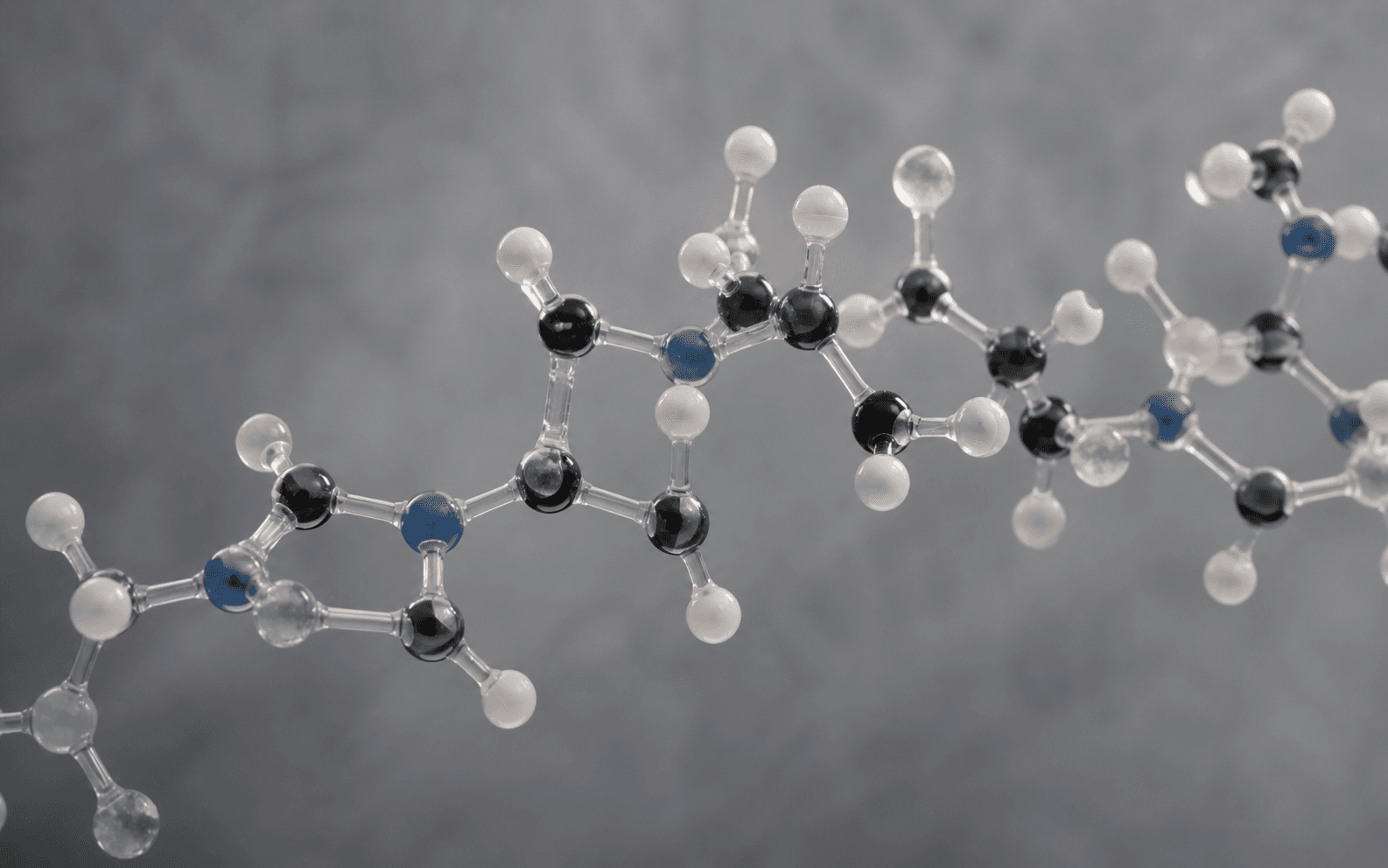
What are peptides, actually?
Short chains of amino acids that carry half the signals in your body. What they are, why the noise, and where knowledge actually ends.
Read articleResearch Library
Articles answer the question up front, state the level of available evidence, and rest on verified sources. No promises, no usage guidance.
Short chains of amino acids that carry half the signals in your body. What they are, why the noise, and where knowledge actually ends.
Read articleA key, a lock, and a signal into the cell. The basic mechanism that explains both the power of peptides and their biggest limits.
Read articleSame building blocks, different chain length — and fundamentally different molecular behaviour. On the border where insulin lives.
Read articleGym talk puts them side by side, but the chemistry, mechanism, and risks of these classes are different. A straight breakdown.
Read articleNot a decorative stamp, not a wink. What this label means legally and factually — and what it doesn't mean.
Read articleResin, coupling cycles, cleavage, purification, drying. The peptide production line — and where its impurities come from.
Read articleThe same word sits on a supermarket tub and a laboratory vial — with almost nothing behind it in common. Separating the categories for good.
Read articleThe loudest pharmaceutical story of the decade is a peptide story. What GLP-1 analogues are, why they worked, and what that says about the class.
Read articleThe question sellers answer far too quickly. Split by category: where data exists, where it doesn't, and what "doesn't" actually means.
Read articleClass S2, the "banned by mechanism, not by efficacy" logic, and strict athlete liability. How anti-doping actually looks at peptides.
Read articleA mitochondrial-derived peptide: how it was discovered, what preclinical research covers, and where the evidence ends.
Read articleThe stable gastric pentadecapeptide: where the name comes from, what animal models show, and the limits of the evidence.
Read articleThe GHK-Cu copper tripeptide: discovery, research directions, and why the form of a commercial material needs its own verification.
Read articleA selective growth hormone secretagogue: how it differs from earlier compounds and where its clinical development stopped.
Read articleWhy "TB-500" and thymosin β4 are not automatically the same thing, and how documentation settles identity.
Read articleOne peptide backbone, two different compounds: how the DAC component changes the molecule and why the names get mixed up.
Read articleThe most-asked question about the most-asked-about research peptide. The answer is short — just not the one the ads give.
Read articleInternet folklore married these two names long ago. What in this pairing is science, and what is retellings of retellings.
Read articleA peptide from the mitochondria that rises with exercise. What the 2015 and 2021 papers actually showed — and where the story ends.
Read articleFrom 1973 blood plasma to cosmetic serums and research vials. The two worlds of one tripeptide, with an honest map of the data.
Read article"Selective" isn't a marketing epithet — it's a term from a 1998 paper. What it means technically, and what it doesn't.
Read articleTwo receptors, one pituitary — and a pair of names the internet welded together. Where the physiology ends and the extrapolation begins.
Read articleFour steps for checking a certificate of analysis — source, batch, method, result — and the typical signs of a weak document.
Read articleHow liquid chromatography works, what the purity percentage really means, and the method's limitations.
Read articleTwo independent figures that constantly get conflated: how 99% purity coexists with underfilling, and which methods measure quantity.
Read articleThe primary method for confirming a peptide's identity: how the measurement works, what a mass match means, and the method's limits.
Read articleA substance identifier, not a quality mark: what CAS numbers are for, why forms of one peptide differ, and when omitting the number is the honest choice.
Read articleWhy peptides are sold as dry powder: the physics of the process, where the stability comes from, and what the form does not guarantee.
Read articleWhite powder tells you nothing about itself. Green flags and red flags when choosing research material — point by point.
Read articleHeat, moisture, light — three ways to ruin material without opening the vial. Peptide degradation chemistry in plain language.
Read articleDry powder can wait for years; a solution can't. The four processes water switches on inside a peptide vial.
Read articleThe number on a certificate is honest only when you know what it measures — and what it doesn't. The arithmetic of synthesis and weight.
Read article