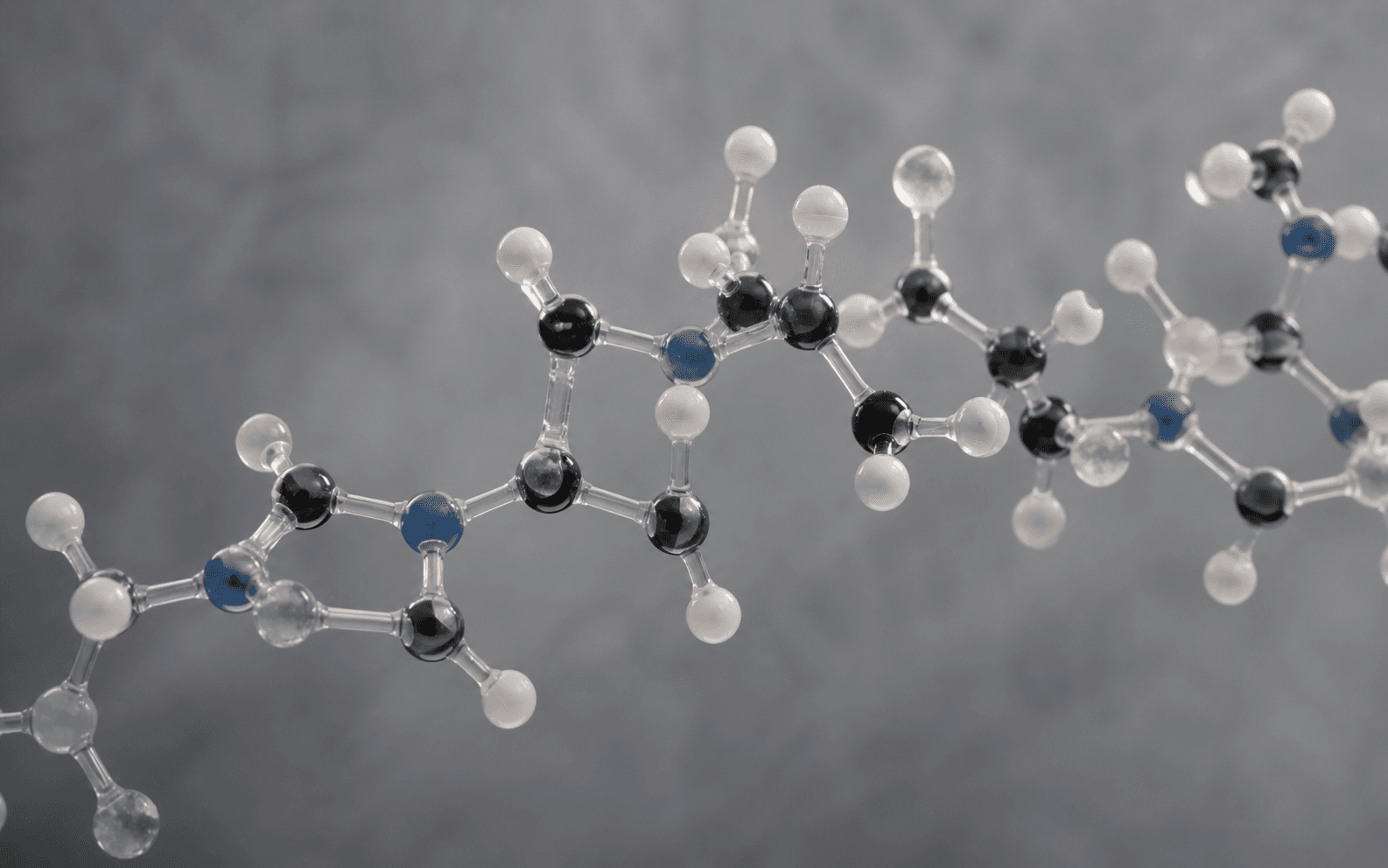
Chemical identity
Every value states its source: database, literature, or calculation. Calculated values are not presented as PubChem data.
| Compound class | Tripeptide and its copper(II) complex |
|---|---|
| Synonyms | GHK · glycyl-L-histidyl-L-lysine · copper tripeptide-1 |
| Formula (GHK) | C14H24N6O4PubChem |
| Mass (GHK) | 340.38 г/мольPubChem |
| CAS (GHK) | 49557-75-7PubChem |
| Formula (GHK-Cu) | C14H22CuN6O4PubChem |
| Mass (GHK-Cu) | 401.91 г/мольPubChemDatabases hold several complex entries differing in how charge and stoichiometry are represented; the neutral 1:1 form is shown. |
| PubChem CID | 73587 (GHK) · 165429100 (GHK-Cu)PubChem |
| Sequence | GHK (Gly-His-Lys)Formula and average mass were independently recomputed from the sequence shown and matched the PubChem record. |
A molecule with a biography
In 1973 Loren Pickart isolated a tripeptide from human plasma that affected liver cells in culture — published in Nature New Biology. The tripeptide — glycyl-histidyl-lysine — turned out to bind copper ions avidly, forming the GHK-Cu complex. The copper gives its solutions their signature blue colour: the most photogenic fact in the catalogue.
Plasma GHK concentrations decline with age — an observation that has kept the molecule interesting to ageing and regeneration research for decades.
Life one: the cosmetic shelf
In cosmetics, GHK-Cu is a legal topical ingredient, and its human data mostly comes from there: small studies of skin parameters under topical application. An honest but narrow genre — small samples, cosmetic endpoints, applied-to-skin format. Conclusions don't stretch beyond that genre.
Life two: the research laboratory
Scientific interest in GHK-Cu runs wider than cosmetics: Pickart's 2018 review collects data on the modulation of a large number of genes in experimental systems — tissue remodelling, antioxidant pathways, neurobiological directions. Mind the genre: cell and animal models, bioinformatics. Controlled clinical trials of systemic effects in humans don't exist.
GHK-Cu in our catalogue belongs to this second life: a research reagent for laboratory work, with batch documentation, and no stretching of cosmetic or preclinical data past where it reaches. Not for human use.
References
- Tripeptide in human serum which prolongs survival of normal liver cells and stimulates growth in neoplastic liver — Nature New Biology, 243, 85–87 (PMID 4349963), 1973.
- Regenerative and Protective Actions of the GHK-Cu Peptide in the Light of the New Gene Data — International Journal of Molecular Sciences, 19(7), 1987 (PMID 29986520), 2018.