First, cut the question correctly
"Are amino acid molecules safe" is a meaningless question: insulin and the death cap mushroom's amanitin are both, formally, peptides. The meaningful question is always about a specific compound and its specific body of data. So we split into categories.
Category one: approved drugs. Behind them stand multi-year clinical programmes with thousands of participants, described side-effect profiles, post-market surveillance. "Safe" here doesn't mean "risk-free" — it means "risks studied and documented".
Category two: research compounds
Here the picture differs, and we say it straight: for most popular research peptides, no controlled human safety studies have been published. There are animal models, cell work, occasionally a handful of small human studies. A systematic dossier doesn't exist.
This implies neither "so it's harmful" nor "nothing bad proven, so it's fine". It implies exactly one thing: the question is open. Anyone answering it confidently in either direction has left the literature behind.
The layer people forget: material quality
Safety has a second dimension, independent of the molecule: what's actually in the vial. An unregulated market means everything from excellent synthesis to powder with unknown impurities. Same molecule on the label — different materials in reality.
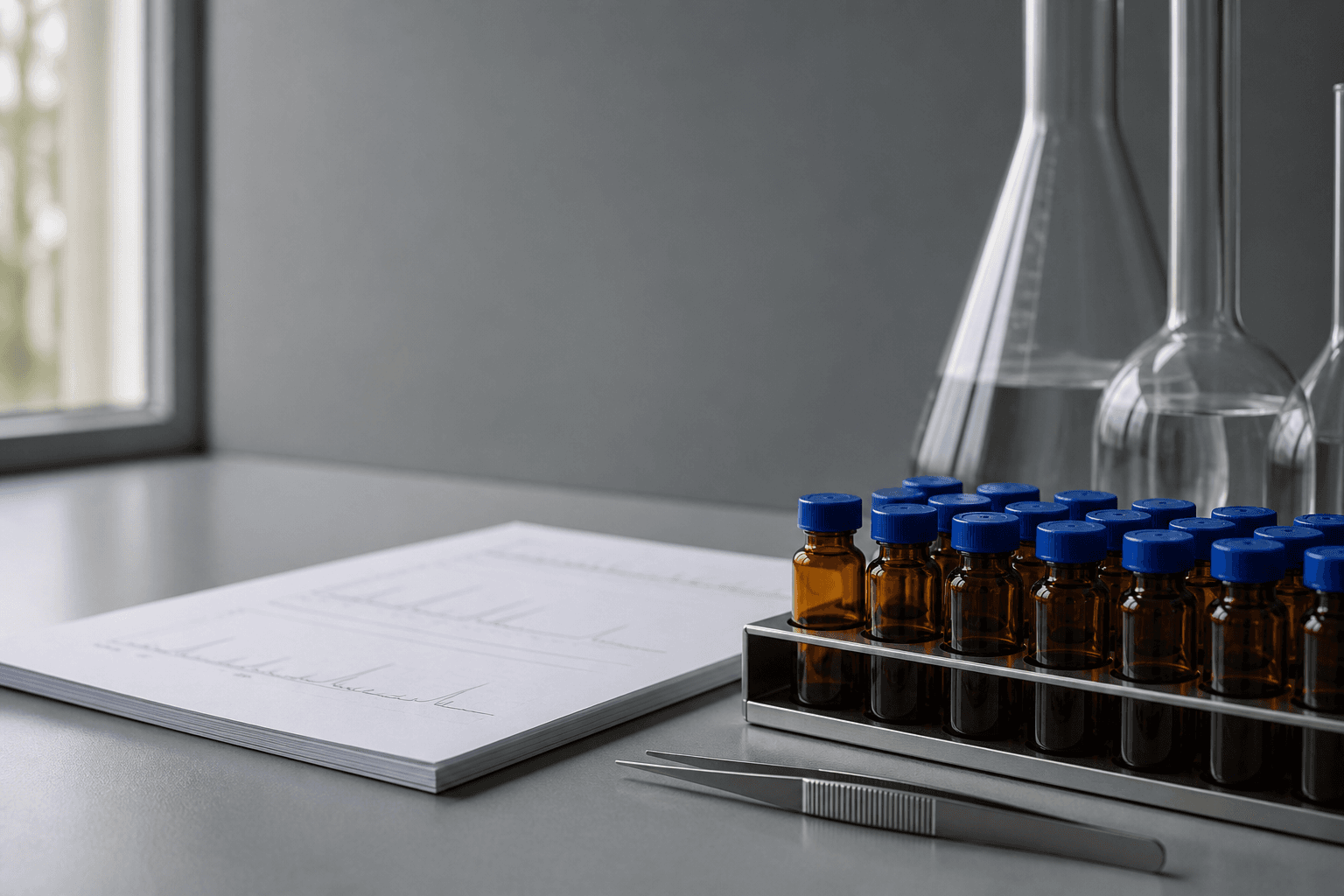
Unlike the clinical dimension, this one is checkable here and now: batch analytics, a chromatogram, a mass spectrum, transparent documentation. That's why we're building a batch-testing system and publish documents as they're verified — see our testing pages for how that works.
The verdict, no anaesthetic
Drugs: studied risks. Research compounds: unstudied ones. Material without documentation: unknown squared. We sell laboratory reagents, give no usage advice, and believe an honest map of the data beats a comforting fog.
References
- Therapeutic peptides: Historical perspectives, current development trends, and future directions — Bioorganic & Medicinal Chemistry, 26(10), 2700–2707 (PMID 28720325; DOI 10.1016/j.bmc.2017.06.052), 2018.
- Trends in peptide drug discovery — Nature Reviews Drug Discovery, 20, 309–325 (PMID 33536635; DOI 10.1038/s41573-020-00135-8), 2021.