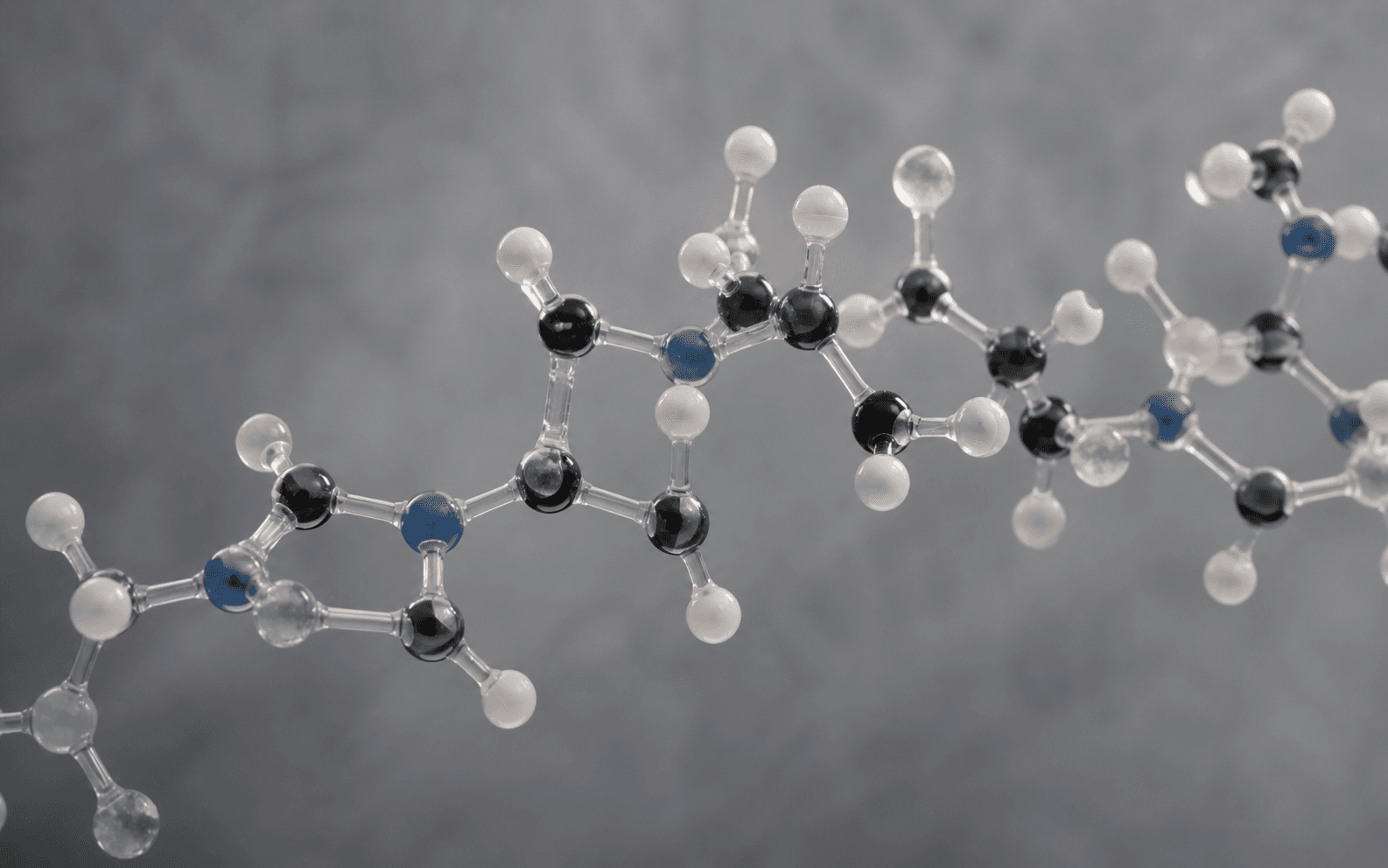
Chemical identity
Every value states its source: database, literature, or calculation. Calculated values are not presented as PubChem data.
| Compound class | Modified analogue of the GHRH(1-29) fragment |
|---|---|
| Synonyms | Modified GRF (1-29) · Mod GRF 1-29 · тетразамещённый GRF(1-29) |
| Formula (with DAC) | C165H269N47O46PubChem |
| Mass (with DAC) | ≈3647.2 г/мольPubChem |
| CAS (with DAC) | 446262-90-4PubChem |
| PubChem CID (with DAC) | 91971820PubChem |
| Formula (No DAC) | C152H252N44O42calculatedCALCULATED value. Derived from the published substitution set [D-Ala2, Gln8, Ala15, Leu27]-GRF(1-29)NH2. No separate authoritative database record is relied on for this form — the value must not be read as PubChem-sourced. |
| Mass (No DAC) | ≈3367.9 г/мольcalculatedCALCULATED value derived from the sequence. The ~280-unit difference from the DAC form allows the two to be distinguished by mass spectrometry. |
| Chain length | 29 остатковliterature |
| Sequence | Tyr-D-Ala-Asp-Ala-Ile-Phe-Thr-Gln-Ser-Tyr-Arg-Lys-Val-Leu-Ala-Gln-Leu-Ser-Ala-Arg-Lys-Leu-Leu-Gln-Asp-Ile-Leu-Ser-Arg-NH2Four substitutions relative to native GRF(1-29): D-Ala at 2, Gln at 8, Ala at 15, Leu at 27; the C-terminus is amidated. The D-amino acid means mass does not confirm stereochemistry. |
A system with two pedals
Growth hormone secretion isn't run by one signal but by a system: hypothalamic GHRH accelerates it, somatostatin brakes it, ghrelin nudges it through its own separate receptor. The two "accelerator" inputs — the GHRH receptor and the ghrelin receptor — operate independently and act in concert in normal physiology.
Now look at the pair: CJC-1295 is an engineered GHRH analogue whose pharmacology in healthy adults Teichman described in 2006; ipamorelin is the selective ghrelin-receptor agonist from Raun's 1998 paper. A molecule for the first pedal and a molecule for the second. The gluing logic is obvious: different inputs, one system.
What's studied, and what's imagined
Studied: each molecule's pharmacology separately, mostly in early-stage and preclinical work. The physiological synergy of the two pathways is documented science too — shown for the system's natural signals.
Imagined: everything else. Published studies of the "CJC-1295 + ipamorelin" combination don't exist — clinical or systematic preclinical. The pair lives in discussions, not in literature. Neither molecule is an approved drug, and both are closed off by anti-doping lists as a class.
One more confusion — inside CJC-1295 itself
Under the name "CJC-1295" the market sells two different molecules: the DAC version — long-lived, hitching onto albumin — and the No-DAC version, more correctly called modified GRF (1-29). Their pharmacokinetics differ fundamentally, and mixing them up means not knowing what you're discussing. We have a dedicated breakdown of this naming pair — required reading before any "CJC" conversation.
Both compounds in the catalogue are research materials for laboratory work on the GH axis. We publish no protocols or regimens: the literature has none, so neither do we.
References
- Prolonged stimulation of growth hormone (GH) and insulin-like growth factor I secretion by CJC-1295, a long-acting analog of GH-releasing hormone, in healthy adults — Journal of Clinical Endocrinology & Metabolism, 91(3), 799–805 (PMID 16352683; DOI 10.1210/jc.2005-1536), 2006.
- Ipamorelin, the first selective growth hormone secretagogue — European Journal of Endocrinology, 139(5), 552–561 (PMID 9849822; DOI 10.1530/eje.0.1390552), 1998.