How the method works
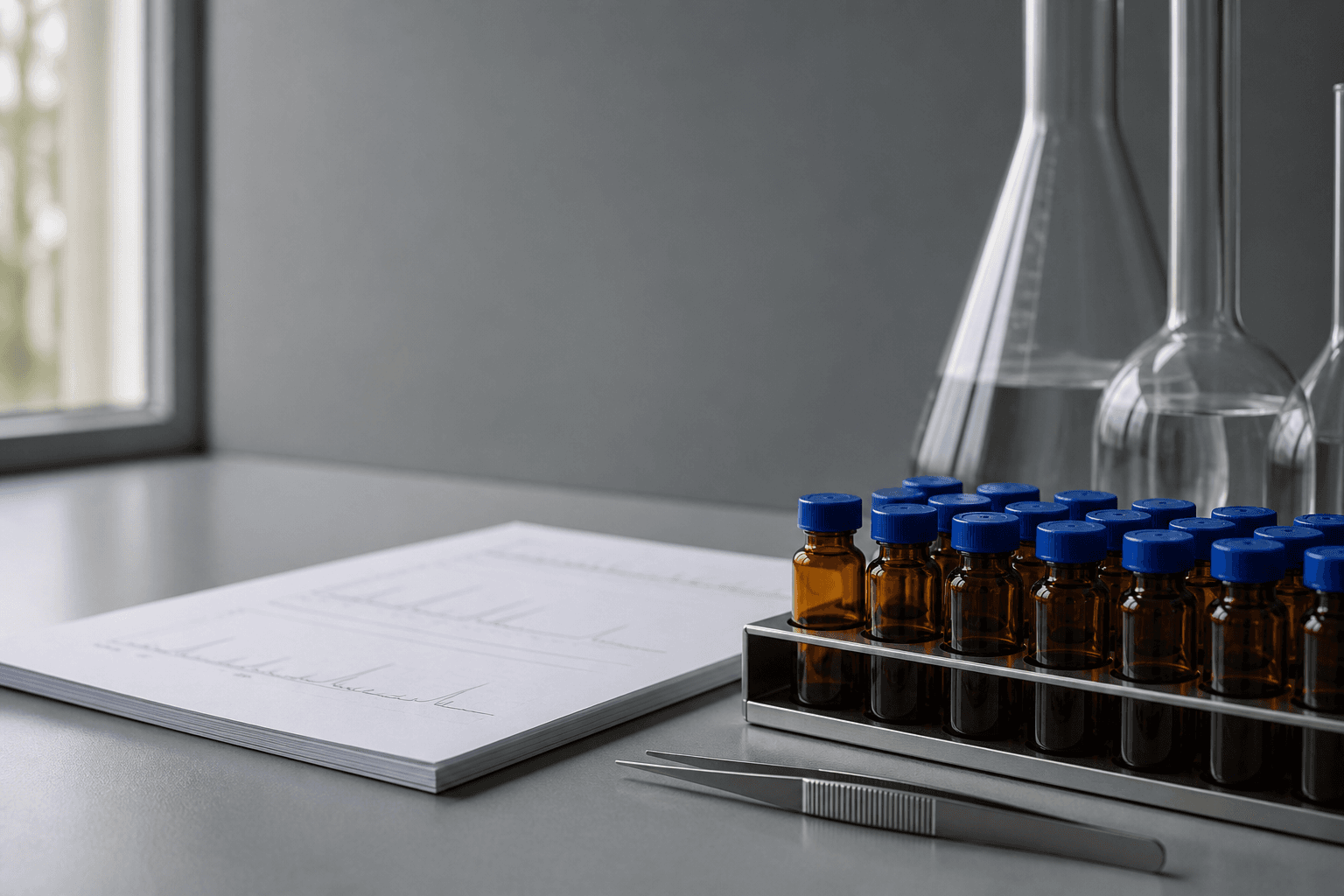
In HPLC, a dissolved sample is pumped under pressure through a column packed with sorbent. Different components travel through the column at different speeds and reach the detector at different times. The result is a chromatogram: a series of peaks whose position characterises each component and whose area reflects its relative amount.
What the purity percentage means
"99% purity" in an HPLC report is the share of the main peak's area in the total area of all peaks registered by the detector under the conditions used — in other words, of what the method saw, 99% was the main component.
"Of what the method saw" is not a technicality. Components that are not retained by the column, absorb poorly at the chosen detection wavelength, or failed to dissolve do not take part in the percentage. Water, residual salts, and counter-ions are also normally outside this figure.
What HPLC purity is not
The purity percentage does not tell you how many milligrams of substance are in the vial — that is a separate property (quantity), measured by other methods. Nor does it prove identity by itself: a highly pure sample can be a highly pure wrong substance. Identity is confirmed by mass spectrometry.
What to look for in a report
A useful HPLC report includes the analytical conditions (column, mobile phase, detection wavelength), the chromatogram itself, a batch number, and a date. A lone "99%" with no chromatogram and no conditions is a claim, not an analytical result.
References
- Reversed-Phase High-Performance Liquid Chromatography in Peptide and Protein Analysis — Encyclopedia of Analytical Chemistry (DOI 10.1002/9780470027318.a1631), 2000.
- Electrospray Mass Spectrometry and Tandem Mass Spectrometry of Synthetic Multicomponent Peptide Mixtures: Determination of Composition and Purity — Analytical Biochemistry, 219(2), 261–277 (PMID 8080083; DOI 10.1006/abio.1994.1266), 1994.