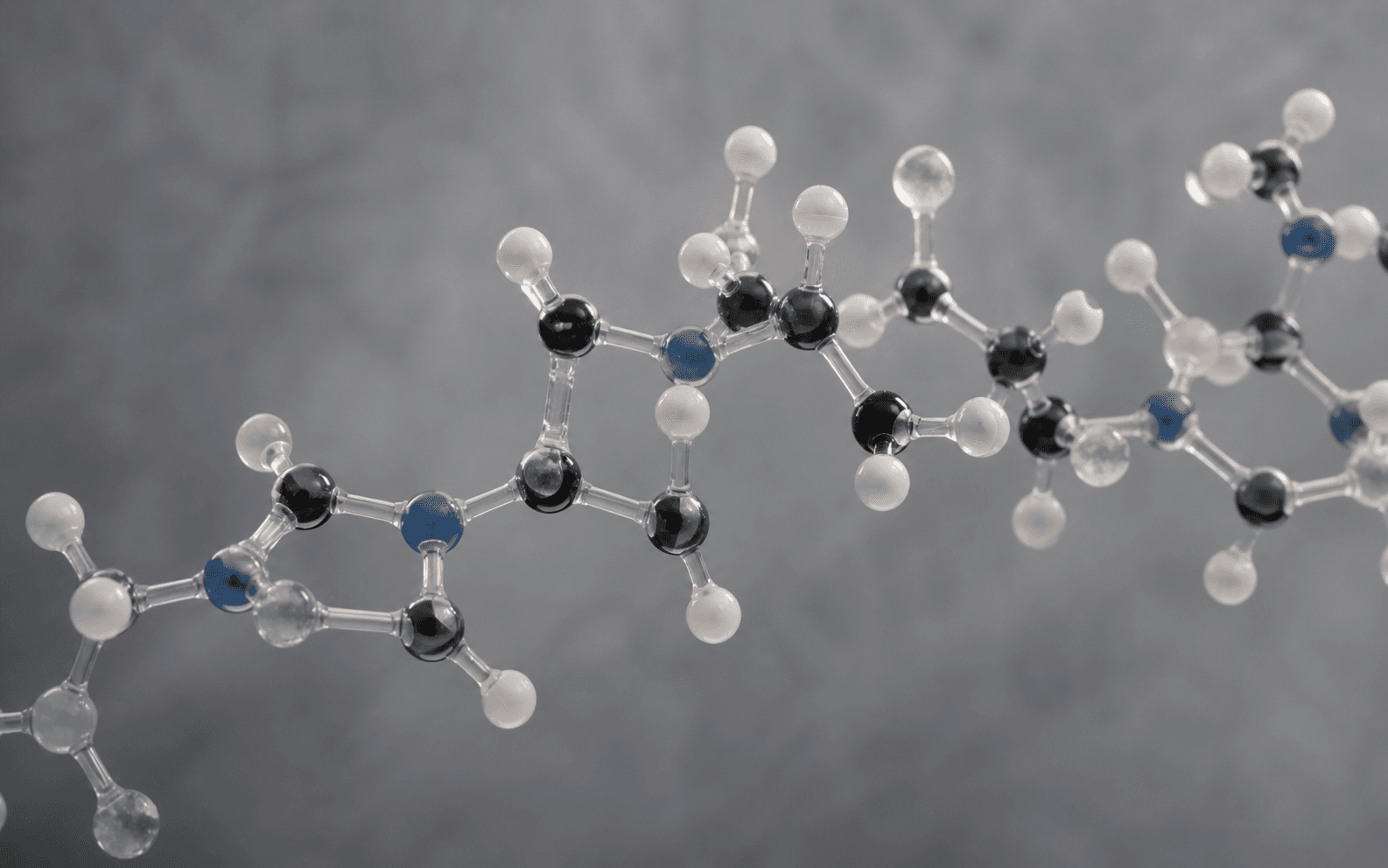
Chemical identity
Every value states its source: database, literature, or calculation. Calculated values are not presented as PubChem data.
| Compound class | Tripeptide and its copper(II) complex |
|---|---|
| Synonyms | GHK · glycyl-L-histidyl-L-lysine · copper tripeptide-1 |
| Formula (GHK) | C14H24N6O4PubChem |
| Mass (GHK) | 340.38 г/мольPubChem |
| CAS (GHK) | 49557-75-7PubChem |
| Formula (GHK-Cu) | C14H22CuN6O4PubChem |
| Mass (GHK-Cu) | 401.91 г/мольPubChemDatabases hold several complex entries differing in how charge and stoichiometry are represented; the neutral 1:1 form is shown. |
| PubChem CID | 73587 (GHK) · 165429100 (GHK-Cu)PubChem |
| Sequence | GHK (Gly-His-Lys)Formula and average mass were independently recomputed from the sequence shown and matched the PubChem record. |
Identity
GHK is the tripeptide glycyl-L-histidyl-L-lysine. It binds copper(II) ions with high affinity and occurs in biological fluids as the copper complex known as GHK-Cu.
The tripeptide was first isolated from human plasma and described by Loren Pickart in 1973. Early work noted that its plasma concentration declines with age — an observation that motivated much of the later research.
Directions of published research
The main directions are skin and connective-tissue biology, wound-model studies, and work on gene-expression changes induced by GHK and GHK-Cu. Clinical data are mostly limited to small topical, cosmetic studies.
Important: the form of the substance
"GHK-Cu" on a label can correspond to different real forms: peptide-to-copper ratio, salt form, and moisture content vary between manufacturers. We therefore do not state a CAS number or an exact chemical form for this material until batch documentation confirms them. That is a deliberate editorial decision, not an omission.
Catalogue status
GHK-Cu in the Moscow Peptides catalogue is a research material for laboratory work, not intended for human use.
References
- Tripeptide in human serum which prolongs survival of normal liver cells and stimulates growth in neoplastic liver — Nature New Biology, 243, 85–87 (PMID 4349963), 1973.
- Regenerative and Protective Actions of the GHK-Cu Peptide in the Light of the New Gene Data — International Journal of Molecular Sciences, 19(7), 1987 (PMID 29986520), 2018.