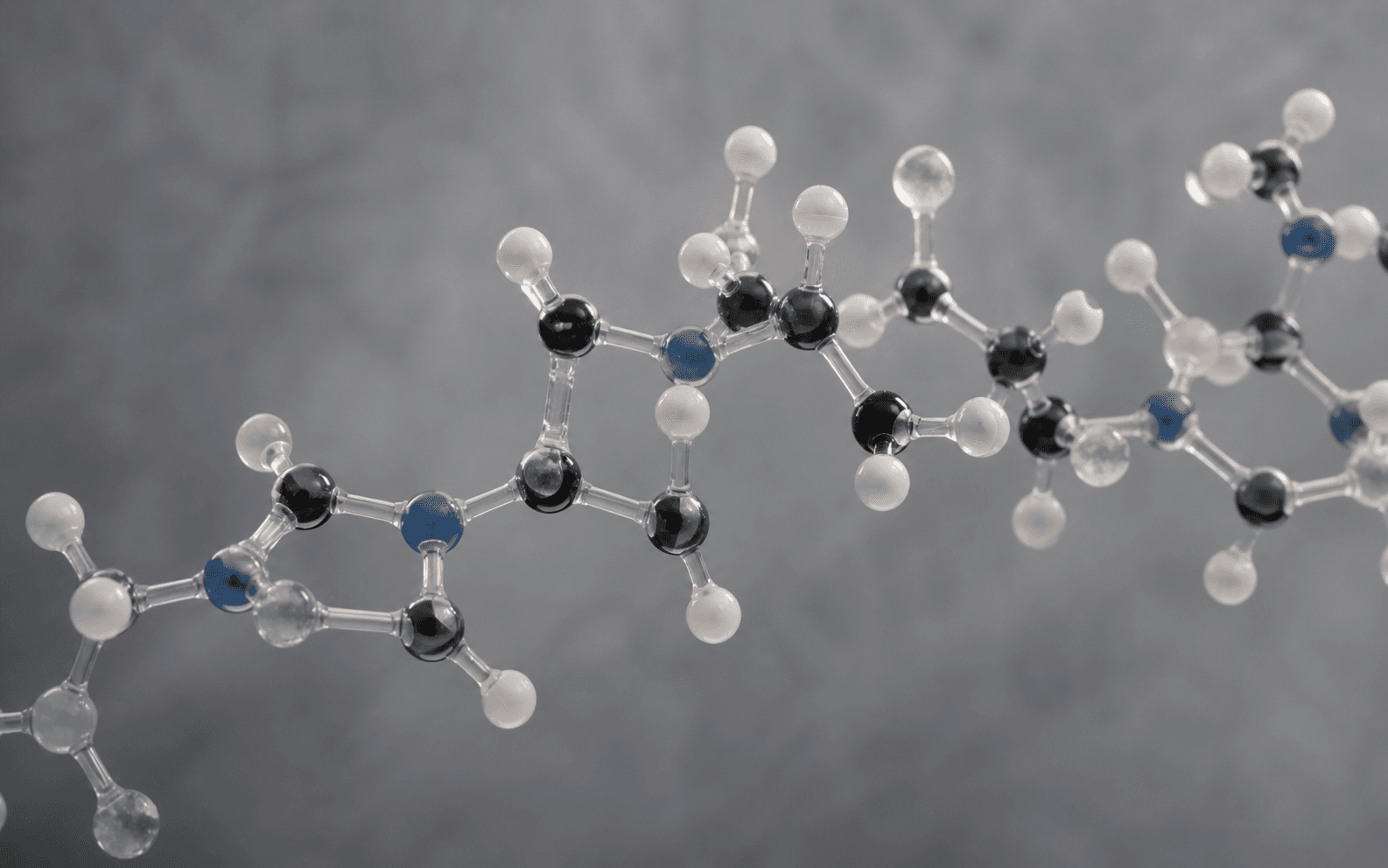
Lock and key
A cell is studded with receptors — protein "locks", each waiting for its molecule. A peptide is a key. The chain's shape and charge decide which lock it fits. When it fits, the receptor shifts shape and fires a cascade of events inside the cell.
The classic example is ghrelin. In 1999, Kojima and colleagues showed in Nature that this stomach peptide binds one specific receptor and triggers growth hormone release. One peptide, one receptor, a measurable response. A large share of your body's signalling chemistry runs exactly like this.
Why that's a strong design
Specificity. Small molecules often hit dozens of targets at once — that's where many side effects come from. A peptide is bigger and carries more chemical information, so it usually recognises its receptor more precisely. GLP-1 is the textbook case: one receptor, a well-mapped cascade, predictable biology.
And why it comes at a price
Your body dismantles peptides fast. Proteases cut the chain; kidneys clear the fragments. Many natural peptides survive minutes in blood. Eating a peptide is usually pointless — your stomach strips it to amino acids before it gets anywhere.
Half of modern peptide engineering is a fight against exactly this: amino acid swaps, protective modifications, conjugation to larger molecules. When you see "modified" in a compound's name, it's almost always about extending the molecule's life, not amplifying its effect.
Where knowledge ends
For approved peptide drugs, mechanisms are mapped in detail, down to receptor complex structures. For many research compounds, the mechanism is a working hypothesis assembled from cell and animal models. That's normal science — but it should be said plainly: "proposed to act via X" and "acts via X" are different statements.
References
- Ghrelin is a growth-hormone-releasing acylated peptide from stomach — Nature, 402, 656–660 (PMID 10604470; DOI 10.1038/45230), 1999.
- Mechanisms of Action and Therapeutic Application of Glucagon-like Peptide-1 — Cell Metabolism, 27(4), 740–756 (PMID 29617641; DOI 10.1016/j.cmet.2018.03.001), 2018.