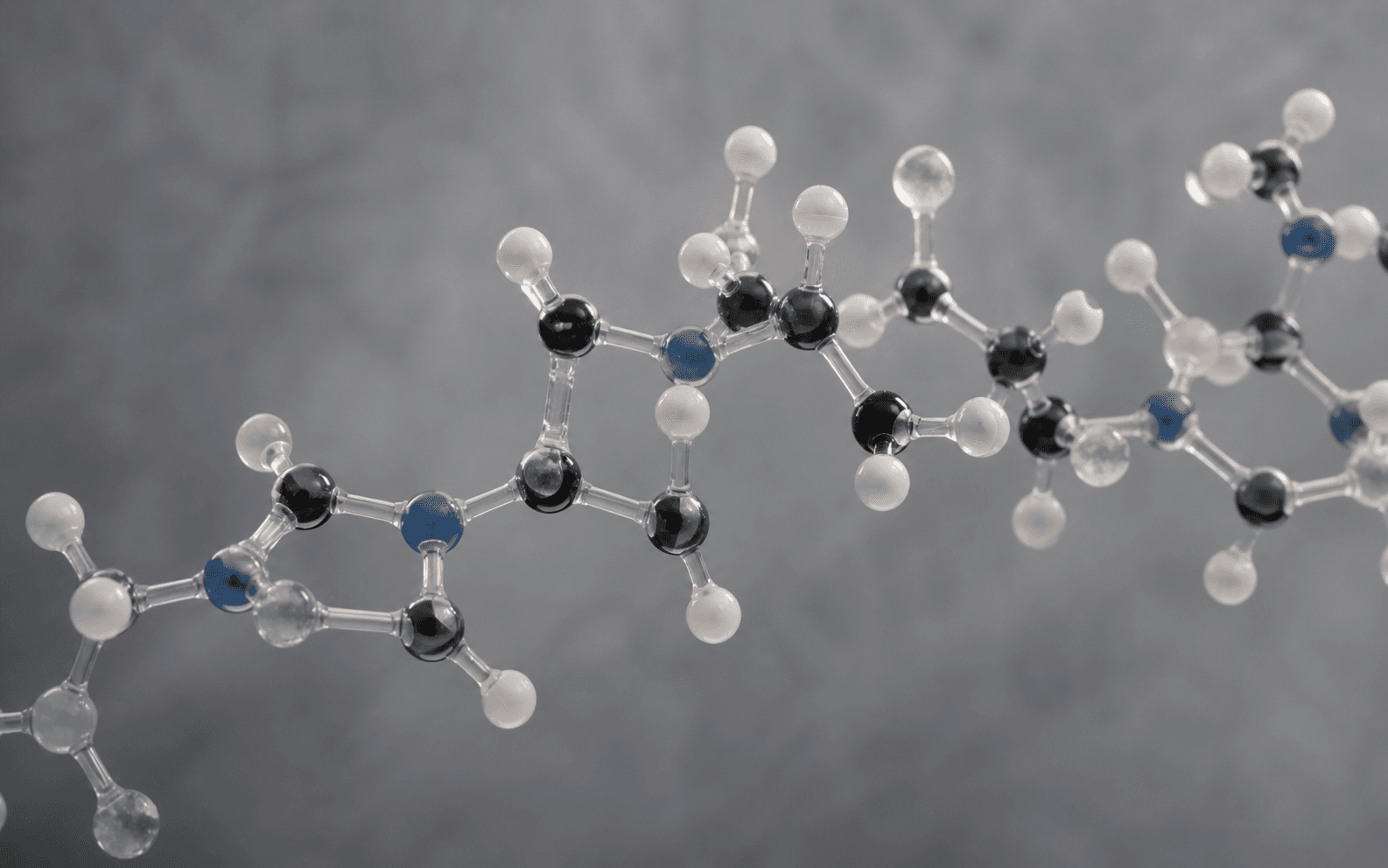
Chemical identity
Every value states its source: database, literature, or calculation. Calculated values are not presented as PubChem data.
| Compound class | Synthetic pentadecapeptide (15 amino acid residues) |
|---|---|
| Synonyms | BPC 157 · PL 14736 · Body Protection Compound 157 |
| Molecular formula | C62H98N16O22PubChem |
| Average molecular mass | 1419.5 г/мольPubChem |
| CAS | 137525-51-0PubChem |
| PubChem CID | 9941957PubChem |
| Chain length | 15 а.о.literature |
| Sequence | GEPPPGKPADDAGLVFormula and average mass were independently recomputed from the sequence shown and matched the PubChem record. |
What "works" means — and in which model
"Works" is a trap word: empty without naming the model. In rodent studies BPC-157 consistently shows effects — faster healing of tendon, muscle, and GI-tract injuries, stimulated angiogenesis, cytoprotection. Sikiric's 2011 and 2018 reviews collect a large body of such studies; the 2021 Frontiers in Pharmacology review consolidates the wound-healing data.
So to the question "does the molecule show biological activity in preclinical models", the literature answers: yes, and it's documented broadly.
Now the uncomfortable part
In humans, BPC-157's efficacy has not been shown. Not "shown weakly" — not shown: no controlled clinical efficacy trials have been published. Everything you've heard about human results is testimonials and anecdotes — the kind of data science doesn't build conclusions on.
The second nuance sellers skip: a substantial share of the animal literature originates from one research group. That's not an accusation — it's a standard caution flag. Science gets solid when independent laboratories reproduce a result; here, independent replications are fewer than one would like.
What would change the answer
A randomised controlled trial in humans — registered protocol, adequate sample, peer-reviewed publication. The month one appears, we update this page. Until then the honest formula is: interesting preclinical record, open clinical question.
BPC-157 in our catalogue is a research material for laboratory work, not for human use. We describe the state of the literature and don't sell you conclusions it doesn't contain.
References
- Stable gastric pentadecapeptide BPC 157: novel therapy in gastrointestinal tract — Current Pharmaceutical Design (PMID 21548867), 2011.
- Novel Cytoprotective Mediator, Stable Gastric Pentadecapeptide BPC 157. Vascular Recruitment and Gastrointestinal Tract Healing — Current Pharmaceutical Design (PMID 29879879), 2018.
- Stable Gastric Pentadecapeptide BPC 157 and Wound Healing — Frontiers in Pharmacology, 12, 627533 (DOI 10.3389/fphar.2021.627533), 2021.