The short answer, with context
GLP-1 — glucagon-like peptide-1 — is a hormone your gut releases in response to food. It tells the pancreas to secrete insulin, slows stomach emptying, and quiets appetite through the brain. Drucker's review in Cell Metabolism maps this system's biology in detail.
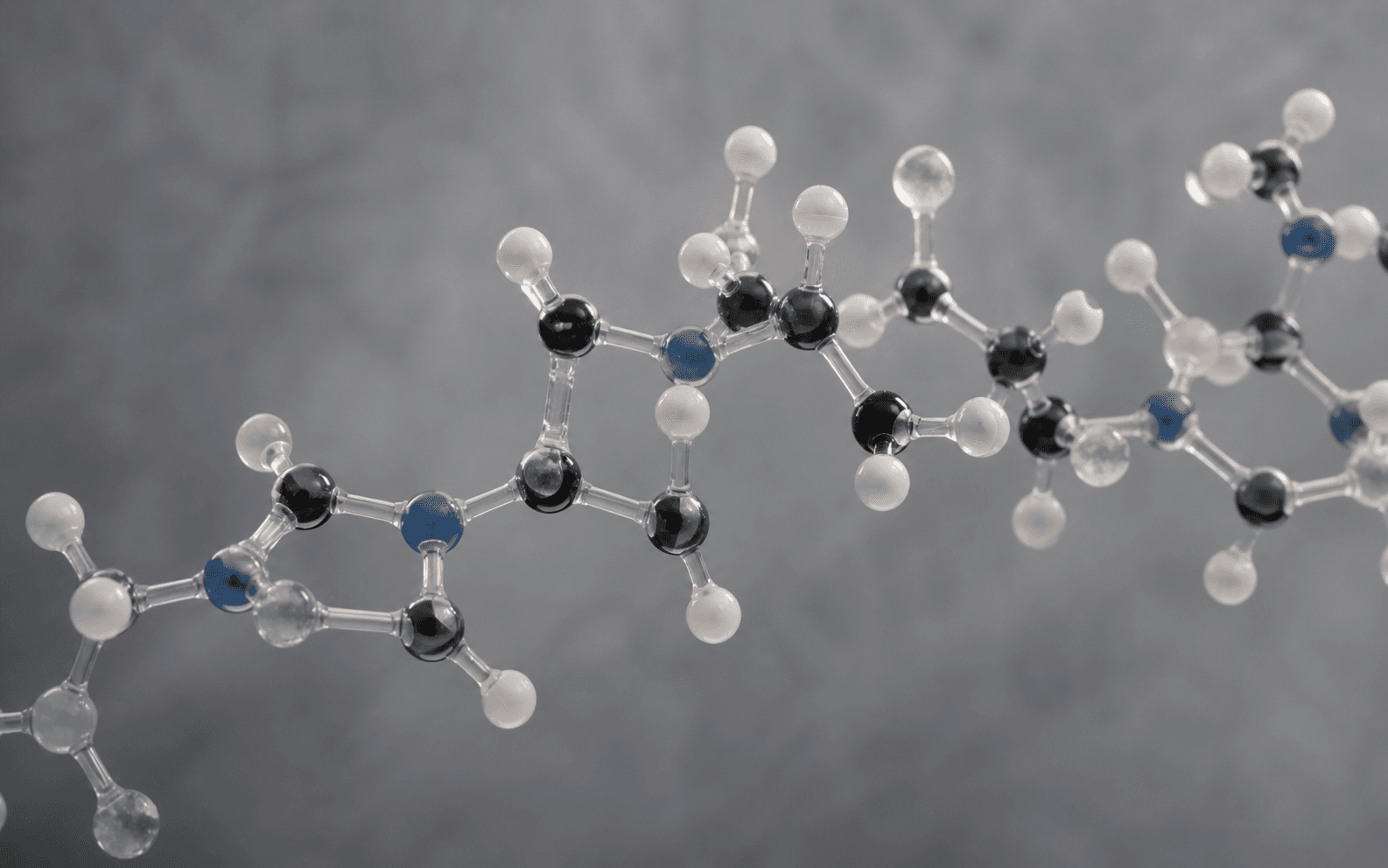
Natural GLP-1's problem: it lives for minutes — the enzyme DPP-4 cuts it almost instantly. Semaglutide is the same peptide, engineered: amino acid swaps to resist the enzyme, plus a fatty-acid "tail" that grips blood albumin and rides it for a week. Beautiful molecular engineering.
Why it changed how the whole class is seen
For decades pharma considered peptides awkward: unstable, useless orally, expensive. GLP-1 analogues proved engineering solves those problems — and that results can be dramatic. In the STEP 1 trial of nearly two thousand participants, semaglutide produced roughly 15% average weight loss against 2.4% on placebo. After that, investment flooded into peptide platforms.
Why we write about it — and what we don't sell
Semaglutide is a prescription medicine. Its use belongs to physicians, with indications, contraindications, and monitoring. It's not in our catalogue and won't be: we work with research materials, not medicines.
We write about it because it's today's best example of a peptide's full journey: from idea-molecule through years of clinical trials to the pharmacy shelf. That journey is the difference between a drug and a research compound. One made the trip; the other hasn't. Everything else follows from that fact.
References
- Mechanisms of Action and Therapeutic Application of Glucagon-like Peptide-1 — Cell Metabolism, 27(4), 740–756 (PMID 29617641; DOI 10.1016/j.cmet.2018.03.001), 2018.
- Once-Weekly Semaglutide in Adults with Overweight or Obesity — New England Journal of Medicine, 384(11), 989–1002 (PMID 33567185; DOI 10.1056/NEJMoa2032183), 2021.